MOI · Themes 3 & 4
Spread
Existence
Dreams, hallucinations, chimerical objects: unusual paths to the same world. And the present that expands beyond the body.
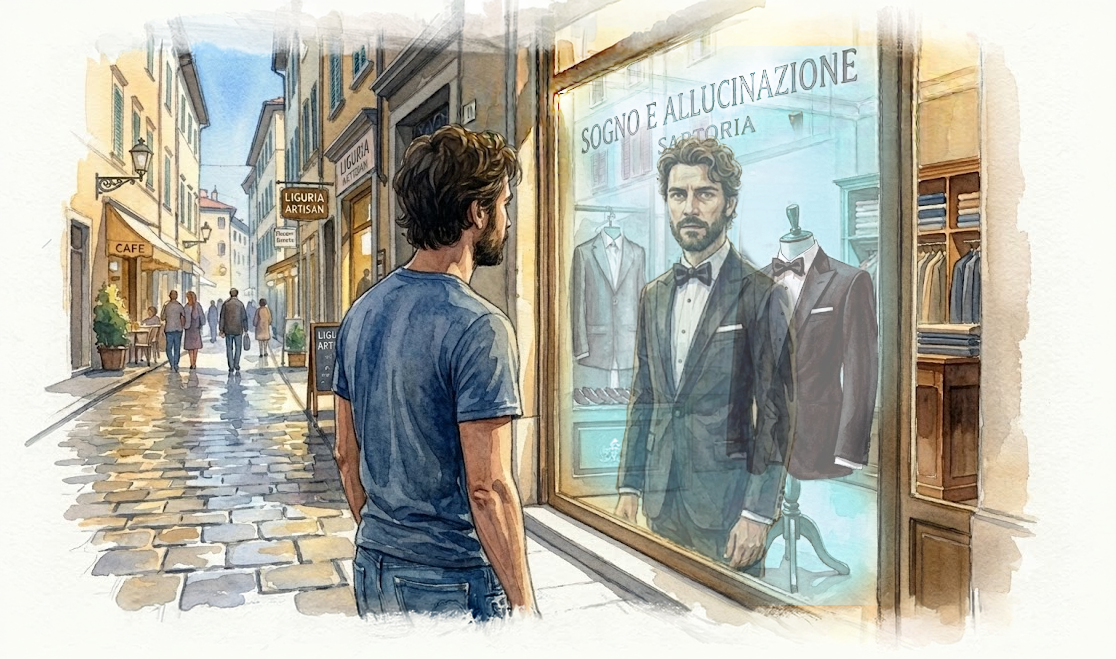
Dreams, hallucinations, chimerical objects: unusual paths to the same world. And the present that expands beyond the body.
The traditional view treats dreams as the paradigm case of mental representation: when you dream, you produce inner images with no external object to justify them. The dream thus becomes proof that consciousness is internal, self-enclosed, severed from the world.
The MOI reads the same phenomenon differently. Consider the image Reflections: a man looks in the mirror and sees himself in evening dress. Not what he is wearing, but something else — as happens in dreams, in hallucinations, in synesthesia. The causal path is unusual, winding, mediated by layers of memory and anticipation. But what is finally brought into existence is still the world.
In a dream you do not reach an imaginary world. You reach the real world through causal traces that the world has left in your brain. A dream of an apple is caused by real apples, by real experiences, by real physical processes that have reshaped your synapses. The dream is an indirect path toward the world, not a flight from it.
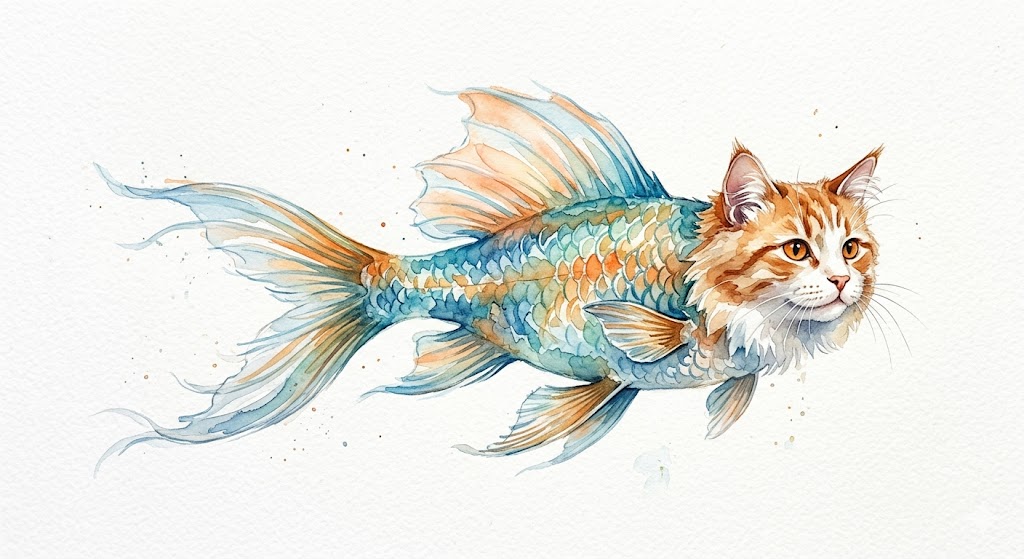
The chimeric object — a fish that is also a cat — seems the perfect example of pure fantasy. But it is made of pieces of the real world, recombined by the brain along eccentric causal paths.
Chimeric object · MOI image
A chimeric object — half fish, half cat — seems the limiting case of mental invention. It does not exist in the world; it is a construction of the imagination. How can the MOI, which wants to identify the mind with real objects in the world, account for such a monster?
The answer is that fish exist, cats exist, and visual structures — the curves of a fin, the texture of fur — exist in the world. The brain invents nothing ex nihilo: it recombines portions of reality. The chimeric object is the causal sum of many real experiences, stacked and reassembled into a single perceptual process. It is no less real than an apple; it is the product of more complex and more mediated causal processes.
All imagination is like this: it is the world taking longer roads. The creative mind is not a mind that frees itself from the real — it is a brain that has stored enough reality to build new configurations. Goya's monsters are made of human flesh, of Spanish light, of history.
At every moment, what you are extends beyond your skull, beyond your skin — as far as the causal process that constitutes you reaches.
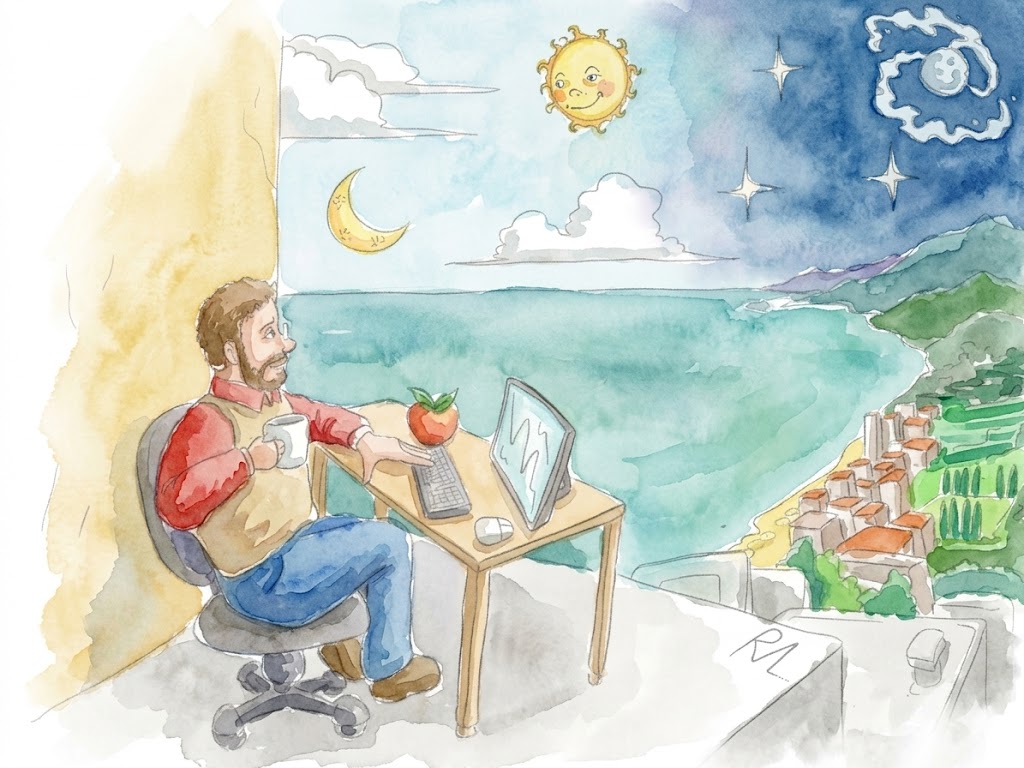
Spread present · the world you are has no boundaries in the skull
Analytic philosophy long debated the "specious present" — the slice of time the mind can grasp as "now". But it always assumed that this present was inside the head: a buffer of milliseconds, a temporal window of the brain.
The MOI proposes a different present: spread, diffuse, physically extended. At every moment, your world includes everything that is causally simultaneous with your body — that is, everything that, by means of your body, produces effects here and now. The light of a star dead for millennia reaches your eyes now: that star is, in a precise sense, part of your present.
This does not mean you are omniscient, nor that your brain knows that star. It means that existence relative to your body is not confined to your skin. The place and time of your existence are not the place and time of your body — they are the place and time of everything that interacts causally with your body.
Existence is not where you are. Existence is everywhere you reach causally.
The preposition makes all the difference. To be in the world is to be a content within a container: the brain inside the skull, the subject inside the body, the mind inside matter. To be of the world is to be an active part of a causal network that has no natural boundary at the skin.
Heidegger intuited something similar with his In-der-Welt-sein, but he resolved it in existential terms, making it a question of meaning and care. The MOI resolves it in causal terms: being-of-the-world is not a structure of human existence but the ontological structure of every process that produces effects.
You are spread: diffuse in space and time as far as your causal influence reaches. Your memories are fragments of the real world preserved as neural structures. Your dreams are indirect paths toward real objects. Your present embraces everything that, through your body, exists here and now. There is nothing mystical in any of this. It is the way causality works.